
Finding and adopting an alternative to VMware represents a top priority for many enterprises, regardless of their size. So, it was no surprise this topic was top of mind for many attendees at the recent Nutanix .NEXT conference.
In discussing this topic with them, one VMware statistic did catch me a bit by surprise. I always suspected a high percentage of enterprises used external storage with their current VMware deployments. However, I heard up to 80 percent of enterprises utilize external storage in conjunction with some of their VMware deployments.
While I could not confirm the source of this statistic, I tend to believe its accuracy. If anything, that helps explain why Nutanix continues to prioritize supporting more external storage systems. That said, Nutanix’s existing and announced support for external storage systems comes with specific qualifications for which enterprises must account.
NVMe/TCP and NFS the New Primary Storage Networking Options
Many enterprises may already use Fibre Channel (FC) to connect their existing VMware servers to external storage systems. Those that do need to reset their storage networking expectations if they plan to use the Nutanix Cloud Platform (NCP).
Currently Nutanix has no plans to support FC either near or long term as a supported storage networking protocol. Rather, enterprises must connect NCP to a storage system using an Ethernet network that supports the proprietary Dell PowerFlex Storage Data Client (SDC) protocol or the more widely available NVMe/TCP or NFS protocols.
Using these protocols will require that enterprises install standard Ethernet switches. This has a “good news” / “bad news” aspect to it. On one hand, Ethernet switches generally cost less than FC switches and enterprises have more providers from which to choose. On the flip side, NVMe/TCP and NFS introduce more overhead on the server and may not achieve the same throughput as FC.
Enterprises with particularly performance-sensitive applications will need to weigh whether they can make this change. This change in the choice of storage networking protocol does not represent the only qualifications which enterprises must consider. They will also find the storage arrays that NCP supports now and into the future come with further considerations.
NCP Already Supports Dell and EverPure
NCP already supports external storage systems from two providers: Dell and EverPure. Currently it supports Dell PowerFlex and three EverPure FlashArray models: FlashArray//X, FlashArray//XL, and FlashArray//C.
Dell PowerFlex
If considering either of these storage systems, enterprises should be aware of the following for each of them. In the case of Dell PowerFlex, enterprises may only run NCP on Dell PowerFlex compute servers and Dell PowerFlex on a Dell PowerFlex storage cluster. In other words, enterprises must deploy an all-Dell hardware configuration. NCP then connects to the Dell PowerFlex storage cluster using the Dell PowerFlex SDC protocol.
EverPure FlashArray//X, //XL, //C
Enterprises that already have or need to use server hardware from another hardware provider may find EverPure a better option. Aside from certifying Nutanix Cloud Infrastructure (NCI) with three different FlashArrays, it also supports server hardware from multiple hardware providers.
Supported server hardware includes Cisco Systems (UCS servers), Dell PowerEdge, and HPE ProLiant/Apollo. In other words, EverPure FlashArray storage systems give enterprises the flexibility to use server hardware from multiple providers. EverPure also differs from Dell PowerFlex in that enterprises must use NVMe/TCP to connect to an EverPure FlashArray.
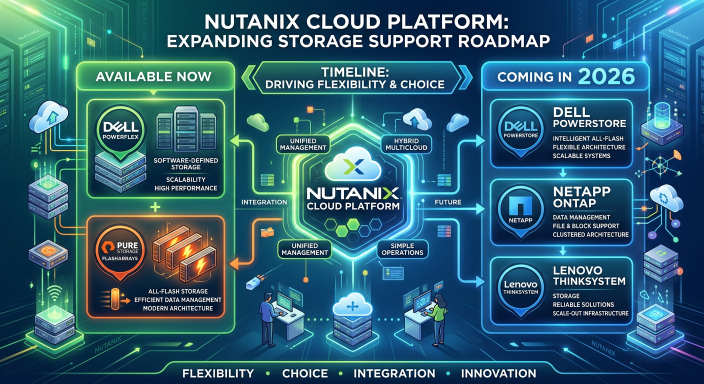
NCP Support for Dell PowerStore, NetApp ONTAP & Lenovo ThinkSystem storage Coming Soon
Nutanix’s support for Dell PowerFlex and EverPure only scratches the surface of the external storage systems in the market. To support yet more external storage systems, Nutanix announced at .NEXT that it will support three more in 2026.
Dell PowerStore
Nutanix support for Dell PowerStore entered early access in Spring 2026 with general availability expected in Summer 2026. Dell PowerStore configurations will most closely mirror how Nutanix supports Dell PowerFlex. Like Dell PowerFlex configurations, enterprises must host NCP on Dell PowerEdge servers and use NVMe/TCP for storage networking connectivity.
NetApp ONTAP
NetApp ONTAP represents the next storage system that Nutanix announced it will formally support yet in 2026. While neither provider has formally published any exact 2026 release date, Q3 2026 seems reasonable. Further, neither Nutanix nor NetApp announced exactly which ONTAP systems NCP will support initially.
That said, Nutanix will likely follow the same playbook with NetApp that it did with EverPure. NetApp has already announced that NCP will support the NetApp AFF all-flash A-series and select FAS hybrid-flash systems. Certifications between NCP and other NetApp ONTAP models will likely follow.
Two other differences also emerge here with Nutanix’s support for NetApp. First, Nutanix will support for NetApp ONTAP using NFS for storage networking connectivity.
The other difference may appear in the flexibility to host NCP on server hardware from multiple providers and still connect to NetApp ONTAP. While neither provider has explicitly made this statement, introducing NFS as a supported protocol would make this a logical conclusion to draw.
Lenovo ThinkSystem storage
Generally availability of support for the Lenovo ThinkSystem Storage will occur on or about the same time as when support for NetApp ONTAP formally becomes available. This stems from the Lenovo ThinkSystem storage using NetApp ONTAP as its storage operating system.
NCP’s support for Lenovo ThinkSystem Storage does, however, differs in at least one way from how NetApp ONTAP supports NCP. Enterprises must host NCP on Lenovo ThinkSystem servers to use Lenovo ThinkSystem storage.
NCP External Storage Support Not a One Size Fits All
Enterprises should rightfully be thrilled that a software provider other than VMware now offers support for external storage systems. Admittedly, other providers do support external storage systems. However, they do not really leverage or harness the capabilities that storage systems offer to support virtualization. NCP changes that by tapping into those capabilities so enterprises can continue to use them even as they adopt NCP.
However, enterprises still must exercise caution as they like to continue using external storage systems with NCP. Those that want to use server hardware from different providers will find they can only use external storage systems from a few providers. Further, enterprises must examine which storage networking protocol they want to use as they go down the NCP path. If they prefer NVME/TCP or NFS, that preference may well determine the external storage system they can select.
Keep up to date with DCIG
To be notified of new DCIG articles, reports, and webinars, sign up for DCIG’s free weekly Newsletter.
To learn about DCIG’s future research and publications, see the DCIG Publication Calendar.
Technology providers interested in licensing DCIG TOP 5 reports or having DCIG produce custom reports on their behalf, please contact DCIG for more information.
Editor’s note: This article was updated on 4/24/2026 at 10:05 am CDT and 11:05 am to reflect the following.
First, Dell PowerFlex uses the Dell PowerFlex SDC protocol, not NVMe/TCP, for storage networking connectivity.
Second, EverPure only currently supports connectivity from the three server hardware providers, not five as this blog post originally listed.
Third, support for Lenovo ThinkSystem storage is not available now but will be available on or about the same time as support for NetApp ONTAP.
Fourth, the image was changed to reflect these two updates.