
What practical business problems can my organization solve using artificial intelligence (AI)? That’s a fair question to ask before an organization prepares to spend perhaps millions of dollars on AI. Yet as more CEOs tell their organizations to do something with AI, organizations face an internal dilemma:
- Do they buy AI first and ask questions about the problems it solves later?
- Do they try to figure out the problems AI will solve and then buy the right AI solution?
- Can they possibly buy AI now and show value from it in the near term?
Many organizations take the third option, buy AI, and then hope it quickly shows value. However, buying AI and hoping it shows value rarely works unless an organization selects an AI solution suitable for its infrastructure.
Even AI Says “Research First, Buy AI Later”
Out of curiosity, I asked ChatGPT the following question: What are some practical first steps that organizations can take when buying AI?
ChatGPT gave me the following 10-point response:
- Define business goals.
- Conduct needs assessment.
- Research vendors.
- Set budget.
- Pilot and test.
- Evaluate scalability.
- Focus on data management practices and use quality data.
- Involve key stakeholders.
- Develop an implementation plan.
- Monitor and evaluate.
In full disclosure, I edited all these points just slightly for brevity. ChatGPT provided an additional sentence or two explaining each point and I re-worded two points for clarity. However, these ten points fundamentally capture the essence of ChatGPT’s response. Further, they seemed self-explanatory, practical, and logical to me.
Do Something with AI
Unfortunately, developing a thought-out AI initiative tends to get shelved when the CEO issues a dictate to buy AI now. IT staff (or whoever) respond to the CEO’s request and go out and buy AI. They then try to figure out how or where to best use it to demonstrate its value to the business.

Having worked in IT for many years, this “Buy first, show value second” approach to adopting new technologies transcends generations. One could argue that the adoption of desktop computing and the Internet in the 90’s were driven by such directives. Then along came the “implement SANs” and “cloud-first” edicts in subsequent decades. Now we see the same push by CEOs to “buy AI and do something with it.”
Looking back, these various initiatives certainly resulted in these technologies going mainstream. However, how much money did organizations spend first before finally figuring out the value of these technologies? This does not even account for the many hours that organizations internally invested in implementing these initiatives.
This pattern seems to be repeating again with AI. Anecdotal feedback that DCIG has gathered indicates that early adopters of AI already have buyer’s remorse. Once purchased, they find AI difficult to implement and even more challenging to derive value from it.
So, they either throw up their hands in exasperation and quit, or they try to find some value from it. Even when they find value from it, the value they derive rarely matches the effort and investment they made in it.
Capitalizing on the “Do Something with AI” Reality
Organizations hoping that CEOs will stop issuing edicts like “Buy AI now” will find themselves doomed to disappointment. CEOs issue directives like that because they know waiting for their organization to internally adopt a new technology rarely occurs organically. I am not saying it never happens, but it rarely happens.
Further, CEOs want their organizations to derive more value from AI than watching employees use AI to write code or plan vacations. CEOs recognize that organizations that utilize AI effectively will achieve a significant competitive advantage in the marketplace. As such, staff should not fight their CEO’s “Buy AI now” directive. Rather, they should identify AI solutions that map to current challenges while presenting nominal risk to the organization when implemented.
Since the 10-step process that ChatGPT initially proposed does not reflect reality, I rephrased the question. I asked, “My boss just told me to buy AI now and to show value from it. Where should I begin?”
It now came back with the following, more realistic six step process:
- Identify quick-win opportunities such as automating simple repetitive tasks, enhancing customer support through chatbots, or improving data analysis.
- Choose a reliable vendor with a readily deployable solution.
- Leverage existing infrastructure with which the AI solution integrates.
- Set clear objectives that you expect AI to achieve to measure success and show value.
- Assemble a small team of key stakeholders who are familiar with AI technology.
- Communicate the benefits to your team and management that quantify time savings, improved accuracy, or enhanced customer satisfaction.
These six steps make more sense considering how organizations operate in the real world. They can check the box of deploying AI now while providing a path for deriving value from AI in the near term. However, to deliver on steps two and three, organizations must identify a reliable provider whose solution leverages their existing infrastructure.
VergeIQ: An Answer to the “Do Something with AI” Now Directive
I recently took the opportunity to discuss this modern-day AI dilemma with Verge.io’s Chief Marketing Officer, George Crump. He acknowledged that Verge.io regularly receives this type of feedback from its current and prospective clients. In fact, Verge.io heard about it so much, it came to market with VergeIQ to specifically addresses this need.

Verge.io built VergeIQ upon its underlying VergeOS infrastructure operating system that organizations can deploy on their existing hardware infrastructure. This mitigates the need to initially buy new hardware simply to deploy AI. More notably, VergeOS includes VergeIQ as part of it thereby making AI a native feature in it.
This integrated software approach enables organizations to immediately deploy AI while avoiding insane hardware bills. Anyone who has looked at the price of an Nvidia data center GPU lately knows just how much they cost. Using Verge.io, organizations can opt to run AI on their existing infrastructure using normal CPUs.
Now will AI run as quickly on the existing infrastructure as using servers with Nvidia GPUs? Probably not. However, organizations can immediately run AI and figure out its value to them. Once they figure out AI’s value proposition, they can then appropriately invest in an GPU-powered hardware infrastructure.
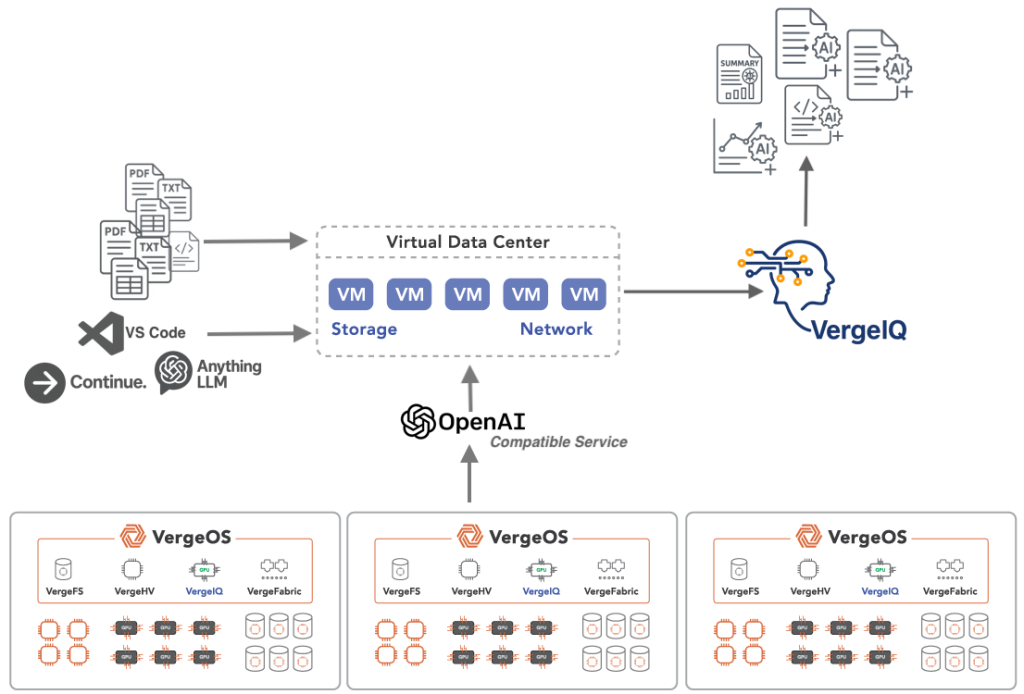
Running VergeIQ also has another benefit. Organizations can run AI in their data center. That gives them complete control over their sensitive documents, their code, and any data that they expose to AI. No worrying about AI engines in the cloud accessing this data since their data never leaves their premises. Further, they control what data goes into the AI engine to improve the quality of their results.
Get Value from AI Now
CEOs will never stop demanding that their organizations buy the latest, greatest technology now. AI merely represents the latest iteration of this never-ending trend. In response, many organizations will “buy AI now” and hope they derive some value from it.
Smart individuals should prepare for this eventuality. To do so, they can look for a solution like Verge.io. Verge.io’s inclusion of VergeIQ in VergeOS and equipping VergeOS to run on almost any hardware makes succeeding with AI viable.
Organizations still need to make their data accessible to VergeIQ and have the right internal stakeholders involved. But for those organizations willing to follow these six steps and utilize Verge.io in the process, AI no longer represents a pipe dream. Rather, they can buy AI and get value from it now.
KEEP UP-TO-DATE WITH DCIG
To be notified of new DCIG articles, reports, and webinars, sign up for DCIG’s free weekly Newsletter.
To learn about DCIG’s future research and publications, see the DCIG Editorial Calendar.
Technology providers interested in licensing DCIG TOP 5 reports or having DCIG produce custom reports on their behalf, please contact DCIG for more information.
Note: Verge.io is a client of DCIG.