
It seems hard to believe that 2024 is almost over with only five days remaining in the year. That means it is time for DCIG to pause and identify DCIG’s most-read blog entries in 2024.
This year I handled the identification of the TOP 5 blog entries differently in two ways. First, I only considered blog entries that covered topics unrelated to the DCIG TOP 5 reports. Next week, I will post a blog entry that highlights the DCIG TOP 5 reports most downloaded from DCIG’s website. Second, I will count them down in the order in which they were the most read. So, without further adieu, here are the DCIG TOP 5 most-read blog entries not related to announcing a specific DCIG TOP 5 report.
#5 Blog Entry: 5 Key Topics to Consider If Choosing a VMware vSphere Alternative
This blog entry, published in June 2024 and came in at #5 identified, a common thread in the focus of the TOP 5 blog entries. All organizations, regardless of their size, appeared to share one objective for 2024: They prioritized identifying an alternative solution to VMware vSphere.
 The significant software licensing changes announced by Broadcom in December 2023 prompted many organizations to consider alternatives to vSphere. While the most appropriate VMware vSphere alternative for each organization will vary, the questions they will need to ask will look similar. Here are five (5) key questions on topics that organizations should ask if they choose a VMware vSphere alternative.
- What guest operating systems do the new platform support?
- What options, if any, does the new platform offer to migrate data off VMware vSphere?
- What minimum server hardware requirements does the new VMware vSphere alternative possess?
- What third-party data protection and external storage options does the VMware vSphere alternative support?
- How well does the VMware vSphere alternative support the compute and storage features in third-party general-purpose clouds?
#4 Blog Entry: Cross-hypervisor VM Migration Already Emerging as a Major Data Protection Trend for 2025
This blog entry was published just last week in December 2024 but clearly hit a nerve as it came in as the #4 most-read 2024 blog entry. In fact, the interest in this blog entry somewhat surprised me as it was a forecast of what I expect to be a major data protection feature in 2025: cross-hypervisor VM migration.
 This blog entry highlighted primary reasons why organizations did not migrate off VMware in 2024. These included:
- They locked in their VMware software licensing for one or more years prior to Broadcom changing VMware’s software licensing model.
- They had no viable alternative hypervisor in mind.
- They had not tested alternative hypervisors with their applications.
- They had not identified any software tools or formally made any plans to facilitate migrating their applications to another hypervisor.
- They had insufficient or no budget and staff to make such a move.
It also highlighted why the pace of organizations migrating off VMware will accelerate in 2025. These reasons included:
- Existing VMware software licenses have begun to expire for organizations forcing them either to re-up or migrate off VMware.
- Alternative hypervisors have added more features to become more viable VMware alternatives.
- Organizations have explored, tested, and validated running their applications and workloads on other hypervisors.
- Organizations have identified tools and made formal plans to move.
- They reserved a budget and allocated staff time to make this move.
#3 Blog Entry: Three Rules for Optimizing Microsoft 365 Recoveries
The #3 blog entry for 2024 published in January 2024 touched on the other major topic of interest in 2024: Microsoft 365. This blog entry examined three rules for optimizing Microsoft 365 recoveries.
The process of backing up and recovering data hosted in Microsoft 365 Online differs in a notable way from other applications and data that enterprises host in the cloud or on-premises. Enterprises do not need to back up and recover the Microsoft 365 application. Rather, they may focus solely on backing up and recovering the data they store in Microsoft 365.
 While this shift in backup and recovery may seem slight, it impacts how enterprises manage recoveries of Microsoft 365 data. They should adhere to the following three rules to optimize and accelerate their recovery of Microsoft 365 data.
- The fastest recovery may involve using Microsoft 365 features.
- Waiting for Microsoft 365 to come back online.
- Taking steps to avoid large scale data recoveries.
#2 Blog Entry: Broadcom Licensing Changes for VMware vSAN 8 Prompting a Reevaluation of HA Solutions for SMB and Edge Locations
The topic for the #2 blog entry released in June 2024 came out of a competitive intelligence report that DCIG prepared for StorMagic. The report itself was a refresh of a report that DCIG initially prepared in 2019 comparing StorMagic SvSAN and VMware vSAN. DCIG’s initial report considered how well each of these two solutions fits in small and midsize businesses (SMBs) and edge locations.
Since then, the operational reality in SMBs and edge locations has changed little. If anything, these size organizations increasingly need cost-effective, reliable highly available (HA) solutions to host their applications and data.
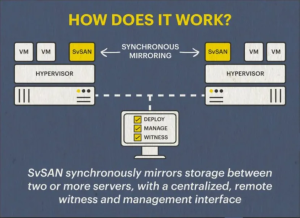 However, significant changes within StorMagic SvSAN 6.3 and VMware vSAN 8 respectively, occurred during this same time. While both solutions made notable improvements to their technical features, VMware vSAN’s software licensing model changed significantly. This blog entry highlights the distinct differences that exist between these two products in the following four areas:
- Software options and associated licensing costs.
- Minimum server hardware requirements.
- Two-node HA cluster configuration.
- Management.
#1 Blog Entry: Microsoft 365 Data Protection Made Better with AI-infused Solutions
The topic for the #1 blog entry released in May 2024 also came out of a technology report that DCIG prepared for Spin.AI. The report itself was an examination of why organizations should still consider third-party backup software for Microsoft 365.
Microsoft only provides some backup and security services to protect Microsoft 365 against ransomware. These include Microsoft 365’s available cybersecurity tools to include Microsoft Defender as well as Microsoft’s now-available Microsoft 365 Backup.
Despite Microsoft making these new backup and cybersecurity tools available, its service agreement continues to recommend using third-party apps and services for data protection.
 This leaves openings for AI-infused solutions such as Spin.ai SpinOne to better protect Microsoft 365. Unlike other solutions, it monitors and protects data while it still resides in Microsoft 365. For instance, it can monitor large or unexpected amounts of read activity on Microsoft 365 data. Since over 90 percent of ransomware events start with data exfiltration, this may indicate an attack has begun.
KEEP UP-TO-DATE WITH DCIG
To be notified of new DCIG articles, reports, and webinars, sign up for DCIG’s free weekly Newsletter.
To learn about DCIG’s future research and publications, see the DCIG Editorial Calendar.
Technology providers interested in licensing DCIG TOP 5 reports or having DCIG produce custom reports, please contact DCIG for more information.ieu