
Having worked for 20+ years in doing technology writing and analysis, I sometimes think I have seen it all. Then I attended the Scale Computing Platform//2025 event in Las Vegas, and experienced two new “firsts.”
Scale Computing’s CEO Jeff Ready orienting his opening keynote around a Robert Frost poem certainly stuck out in my mind. However, seeing a Scale Computing solution deployed above a commercial kitchen sink in an edge site left me almost stunned.

Too Many Opportunities
Hearing poetry read during an opening keynote at a technology conference was, to say the least, unexpected. Having attended dozens, if not hundreds, of conferences during my tenure as an analyst, I have seen many different types of opening. Acrobats, comedians, glitzy videos, movie stars, musicians, politicians, you name it, I have probably seen or experienced it. But … poetry, yeah, this was a first.
However, Scale’s CEO Jeff Ready did more than simply read Robert Frost’s poem, The Road Not Taken. After reading it, he made the poem the foundation – dare I say platform? – of his entire opening keynote.
Like many other hypervisor providers, Scale Computing has directly benefited from the VMware software licensing changes made by Broadcom. Suddenly doors into many customer accounts that were long closed or, at best, partially ajar, have been thrust open.
This creates many enticing new sales opportunities for VMware competitors such as Scale Computing to pursue. In some respects, almost too many. VMware has a presence in many different types of IT environments. Its reach encompasses everything from very large data center environments to edge environments to everything in between.
Trying to pursue all these opportunities with all these different types of IT environments does not equate to future success. Rather, it could spell disaster for a provider such as Scale Computing. Enter too many IT environments for which it does not have the optimal solution, and it gets stretched too thin. Scale Computing now had to determine how to best optimize its solution to differentiate itself in the hypervisor market.
The Enterprise Road
Optimizing its solution for data center and edge deployments represent the two paths forward that Scale Computing most seriously contemplated. Considering these two prompted Scale Computing’s CEO Jeff Ready to reflect upon Robert Frost’s poem, The Road Not Taken.
On the one hand, it would need to optimize its solution for deployment in enterprise data centers. Going down this path had multiple implications for Scale Computing. This would require Scale to minimally invest significant resources to:
- Certify its solution to host multiple enterprise applications.
- Provide more robust support for external storage arrays.
- Refocus its sales and technical support teams to support enterprise accounts.
Then even if it did so, Scale Computing would immediately encounter both Nutanix and Broadcom/VMWare in these environments. This currently puts Scale Computing at a disadvantage. Broadcom/VMware intends to continue to focus on enterprise data centers even as Nutanix ramps up its offering. This would force Scale to compete against both Nutanix and VMware.
Edge Represents the Road Not Taken
In Scale’s case, going down the road that takes it into edge IT environments presents an intriguing path. Providers and analysts tend to dismiss the edge as less lucrative or viable than enterprise data center environments. However, in Scale Computing’s evaluation of edge environments, it sees greener pastures for multiple reasons. These include:
First, edge environments represent the ones most likely to move away from VMware. While VMware has made improvements in its technology for edge deployments, those improvements rarely account for cost. If anything, deploying VMware at the edge requires a significant investment in both hardware and VMware software licensing. In contrast, Scale Computing introduced a software-defined version of its software that organizations may host on multiple hardware platforms.
Second, the edge represents the future of computing as much as the cloud. No organization can run all its applications in the cloud for multiple reasons. Rather, they often need to run applications at the edge for faster processing. They cannot afford high bandwidth connections for their edge environments. They collect great amounts of data at the edge, of which only a fraction they need to transmit to a central site.
Further, once organizations successfully deploy one application at the edge, they may need to run more applications at the edge. This especially holds true for organizations wanting to run artificial intelligence (AI) and machine learning (ML) algorithms. Using AI and ML, they can analyze collected data at the edge and then transmit the results. This expedites the analysis while lowering data transmission costs.
Third, successfully managing edge deployments requires a different set of tools than managing data center deployments. The phrase “fleet management” may seem foreign to those who manage data centers. However, a robust fleet management utility becomes essential to those who manage edge environments. They must remotely patch and fix applications and operating system software as well as the firmware found on hardware. Further, organizations with tens, hundreds, or thousands of edge sites do not have the luxury of “sneaker net” support.
In data centers, an individual can walk into the data center and potentially physically access the device. In edge environments, any physical intervention may require hours of driving to get to the site. Then the individual must hope they have the right equipment and knowledge to fix the issue. Otherwise, another round trip may be required to resolve the issue.
Here again, Scale Computing (SC) recognized that it already possesses a substantial competitive advantage with its SC//Fleet Manager solution. Using this feature, organizations may remotely manage and maintain SC clusters. Further, they may even use SC//Fleet Manager to migrate from VMware or Hyper-V to SC//HyperCore.
The Challenges of the Edge
Yet in choosing to go down this path, Scale Computing had to make accommodations for the challenges of edge environments. It does so in two ways.
First, it offers a diverse line of all-in-one turnkey SC/Hardware appliances. These come preconfigured with hardware and the SC//HyperCore software. Scale Computing then makes at least seven different models available to meet the needs of different sized environments.
Second, it also made its SC//HyperCore available as a software-defined solution. This has become a requirement for multiple different reasons. The most obvious reason stems from organizations who recently acquired server hardware to host VMware. Now facing increased VMware software licensing costs, they want to repurpose this hardware and use it to host SC//HyperCore.
However, the all-in-one models that Scale Computing offers cannot account for every environment that exists. For example, Royal Farms, a convenience store provider that operates in the eastern US, gave a presentation at the conference. Operating over 300 retail stores, the interiors of these stores vary widely.
While its more modern stores make accommodations for IT infrastructure, its older ones often do not. One picture its IT team shared while at the conference showed them having to install Scale Computing above a commercial kitchen sink. This one got my attention.
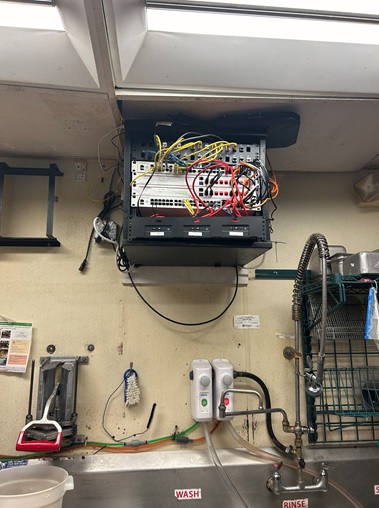
While no one disclosed the type of server hardware used in this deployment, I doubt it was one of Scale Computing’s all-in-one appliances. I suspect it was from a third-party hardware provider that offered a ruggedized hardware configuration. Further, I doubt this represents the only edge environment that Scale Computing will encounter that requires specialized hardware. (Scale Computing informed me after I posted this blog entry this server hardware was from Simply Nuc.)
Organizations Should Now Equate Scale Computing with the Edge
Scale Computing by no means intends to stop competing in data center environments. It certainly offers features and configurations that permit it to compete in these environments. However, Scale Computing felt it had to make a choice on which type of environment to prioritize supporting in its future development efforts: the data center or the edge.
In looking down these two paths, it determined the edge presented the best opportunity for it to succeed. It capitalizes on its inherent strengths, it sees a roadmap for significant growth in these areas, and it did not see many competitors there. Further, these organizations seem to be the most willing and eager to explore VMware alternatives.
From my viewpoint, I agree with its rationale and decision. Its focus on the edge will significantly differentiate itself from other competitors. Further, it has made the internal changes necessary to accommodate those organizations that need a viable, robust hyperconverged solution in their edge environment.
KEEP UP-TO-DATE WITH DCIG
To be notified of new DCIG articles, reports, and webinars, sign up for DCIG’s free weekly Newsletter.
To learn about DCIG’s future research and publications, see the DCIG Editorial Calendar.
Technology providers interested in licensing DCIG TOP 5 reports or having DCIG produce custom reports on their behalf, please contact DCIG for more information.