
Last week, Nutanix held its annual .NEXT user conference in Washington, D.C., my first time attending a conference there. Attended by more than 7,000 individuals, Nutanix had a captive audience to present its latest technological advancements and roadmap. In considering the information that Nutanix presented, the elephant in the room and support for external storage stood out.

Takeaway #1: The Elephant in the Room
Regardless of where one went while attending Nutanix .NEXT, one cannot help but see the elephant in the room. The proverbial elephant in this case represents VMware. Whether walking the show floor or listening to presentations, the topic of VMware inevitably came up.
On one hand, how can the topic of VMware not come up? As Nutanix’s largest competitor, Broadcom continues to modify how it licenses VMware software that often increases costs. Whether changing to subscription-based licensing or increasing its minimum software licensing per CPU core, any organization using VMware has been impacted. This has prompted many existing VMware customers to compare Nutanix’s solutions to VMware’s.
To Nutanix’s credit, it acknowledges how Broadcom’s changes to VMware have driven its existing customers to evaluate Nutanix. However, Nutanix’s Senior VP of Product and Solutions Marketing, Lee Caswell, astutely observes, “VMware customers may want to leave Broadcom. However, we must give them a reason to come to Nutanix.”
Enabling organizations to leave VMware and adopt Nutanix shows up in at least two areas:
- Workload migrations. Nutanix and many of its partners explained how organizations could migrate workloads from VMware to Nutanix. These included new features they have introduced into their solutions to facilitate these migrations.
- Software licensing allowances. Nutanix will make provisions for how it charges for its software licensing when organizations migrate to Nutanix. Any software licensing provisions made depend upon the number of workloads being migrated to Nutanix and how long they take to complete.
Takeaway #2: Nutanix Broadens External Storage Support
To say that Nutanix avoided supporting external storage has the same connotation as saying Superman avoided Kryptonite. Nutanix long viewed external storage as the antithesis of how one should deliver a hyperconverged platform. This view led Nutanix to configure its Acropolis Operating System (AOS) to initially only support internal storage. Further, Nutanix has optimized AOS to perform as well as or better than external storage in recent performance benchmark tests.
However, putting an elephant in the room (see Takeaway #1 above) tends to change one’s viewpoint. VMware’s support for external storage systems prompted Nutanix to reassess its position on external storage. To effectively compete in many enterprise accounts that use VMware, Nutanix recognized it would also need to support external storage.
That reassessment led Nutanix to extend its support for external storage at the 2025 .NEXT conference. Nutanix has previously announced it was going to support external storage at the 2024 .NEXT conference. That announcement came to fruition just prior to the start of the 2025 .NEXT conference with Nutanix formally supporting Dell PowerFlex.
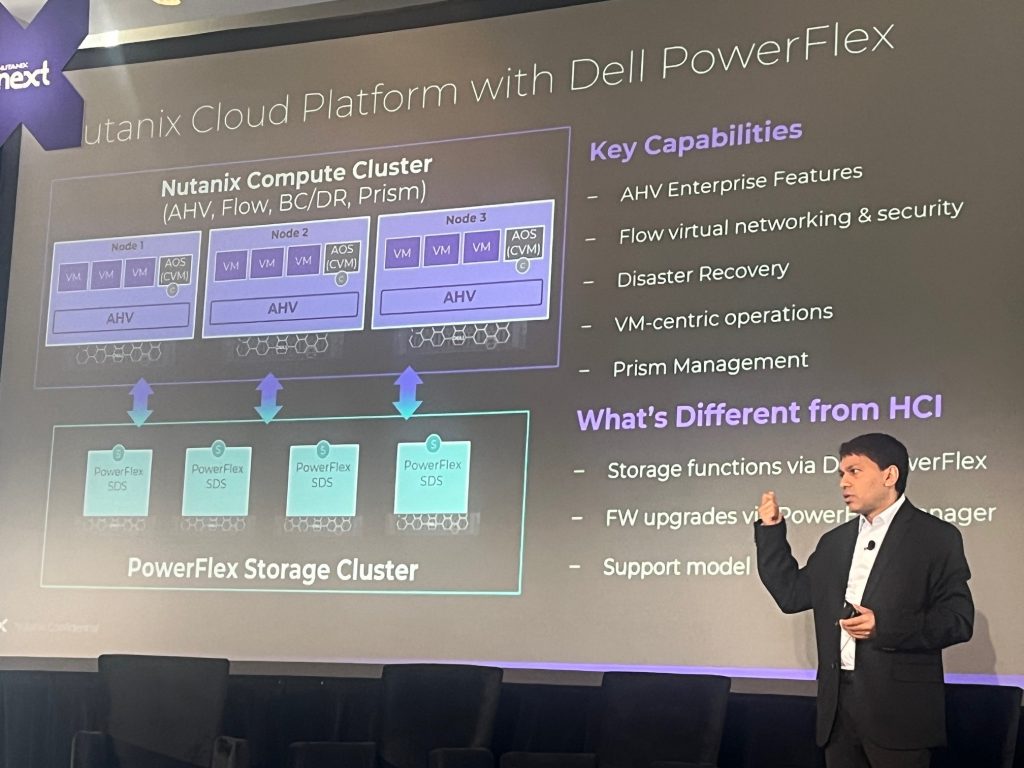
In evaluating this integrated Nutanix-Dell PowerFlex solution on the Solution Expo floor at the event, one caveat jumped out. One had to install PowerFlex software drivers on any Nutanix Controller Virtual Machine (CVM) that were to use Dell PowerFlex. As such, Dell PowerFlex represents the only external storage that Nutanix currently and formally supports.
NVMe/TCP Connectivity the Real Significance of Pure Storage Support
Nutanix’s announcement of its forthcoming support for Pure Storage flash arrays represents a far more significant milestone. Pure Storage admittedly has a larger user install base than PowerFlex, which alone makes it noteworthy.
However, the larger significance of this announcement stems from how Nutanix will connect to Pure Storage arrays. Rather than using a specific software driver, Nutanix will use NVMe/TCP to interact with Pure Storage arrays.
Pure Storage systems may be the first provider that Nutanix formally supports using this protocol. However, it opens the door for Nutanix to support storage systems from other storage providers sooner rather than later.
Bigger questions that now loom for current VMware customers and Nutanix center around Nutanix’s support for fibre channel (FC). Many large enterprise VMware shops use FC to connect to external storage systems. Will these organizations find NVMe/TCP sufficient to meet their external storage needs? Or will they ask for – and will Nutanix respond – with support for FC? Here, the future – and Nutanix’s plans to address FC – remain less clear, to say the least.
KEEP UP-TO-DATE WITH DCIG
To be notified of new DCIG articles, reports, and webinars, sign up for DCIG’s free weekly Newsletter.
To learn about DCIG’s future research and publications, see the DCIG Editorial Calendar.
Technology providers interested in licensing DCIG TOP 5 reports or having DCIG produce custom reports on their behalf, please contact DCIG for more information.