
For years, organizations have focused on data protection as the end goal—backups, replication, disaster recovery. However, that mindset no longer suffices. Today businesses need resilience. They must possess the ability to withstand, respond to, and rapidly recover from disruptions—whether operational, cyber-related, or infrastructure-driven.
👉 Check out the event and register here: Backup & Baseball at Riders’ Field in Frisco, TX
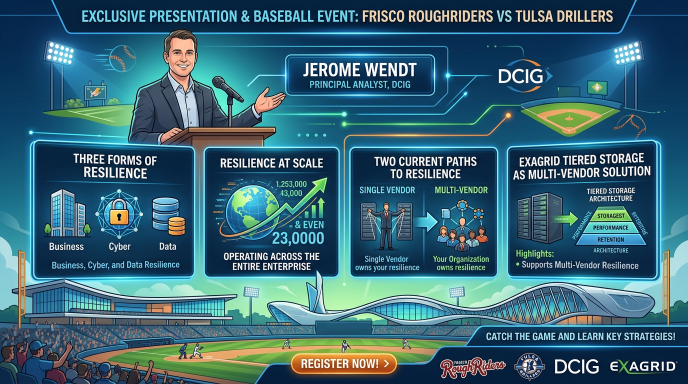
Three Forms of Resilience
Resilience shows up in at least three forms. These include:
- Business resilience ensures operations continue despite outages.
- Cyber resilience prepares organizations to detect and recover from attacks like ransomware.
- Data resilience ensures that data remains available, secure, and recoverable under any circumstance. Together, these form a broader, more meaningful objective than traditional data protection ever could.
To achieve true resilience, organizations must implement a wide range of capabilities—not just backups. These capabilities may include anomaly and ransomware detection, backup and recovery, DR, encryption, immutability, HA, MFA, and replication.
It now also extends into newer domains like data security posture management (DSPM) and identity protection. Add in operational elements like run books and data mobility, and it becomes clear: resilience represents an ecosystem, not a feature.
Resilience Must Operate at Scale
In considering their options for resilience, enterprises must identify resilient solutions that scale. Supporting resilience for a handful of applications no longer cuts it. Organizations today manage highly interconnected applications that depend on each other in ways that organizations may not fully understand.
A failure in one system can cascade quickly. To address this, organizations need centralized visibility and management across all data protection functions to ensure coordinated response and recovery.
Not surprisingly, major technology vendors have taken notice. “Resilience” now appears prominently in marketing messaging, product roadmaps, and solution positioning.
However, most current offerings still fall short. They often define resilience narrowly with capabilities limited to what their own products can deliver. Many solutions only manage resilience across a subset of their portfolio and struggle to integrate third-party technologies. True, enterprise-wide resilience—spanning multiple vendors and platforms—remains elusive.
The Current Two Paths to Resilience
Looking ahead, organizations will likely take one of the following two paths to achieve resilience.
- Rely on a single vendor to deliver resilience end-to-end.This approach may mature closer to 2030, but it comes with trade-offs. Expect all solutions to come from a single vendor, higher costs, reduced flexibility, and a reliance on that vendor’s definition of resilience. In this model, the vendor effectively “owns” your resilience strategy.
- Use one or a few data protection providers.The second approach maintains flexibility across hardware and infrastructure. Also expect it to emerge more quickly, potentially by 2027–2028. It allows organizations to continue using their existing investments while reducing costs. Further, the advances in AI and automation have made managing multi-vendor environments increasingly feasible. The trade-off? Organizations must own their resilience strategy.
ExaGrid’s Resilience Play
Solutions like ExaGrid Tiered Backup Storage come into play in this second scenario. ExaGrid does not try to be an all-in-one resilience platform. Instead, it focuses on performing one task exceptionally well: serving as a high-performance, cost-effective purpose-built backup appliance (PBBA).
ExaGrid integrates with multiple backup software providers, supports immutable storage, enables fast backups and restores, and includes features like Auto Detect & Guard and multi-factor authentication (MFA). Its scale-out architecture supports environments from remote offices to large enterprises.
ExaGrid fits squarely into the second camp, making it ideal for organizations that want to build resilience on their own terms. As a flexible, purpose-built, backup software agnostic solution, it complements broader organizational resilience strategies without dictating them.
Engage with Strategic Storage, ExaGrid, DCIG and RoughRiders Baseball in Frisco, TX
If these trends resonate with you—and they should—there’s an opportunity to explore them live and in person further. DCIG’s Principal Analyst, Jerome Wendt, will present these ideas in person at an upcoming live event hosted by Strategic Solutions. The event will begin about 45 minutes before the start of the Tuesday afternoon, April 21st, 2026, Frisco RoughRiders baseball game in Frisco, TX.
After the presentation, stick around to enjoy lunch, watch the game, and try to stump Jerome on how to achieve resilience in your environment. It’s a great chance to dive deeper into what resilience really means, how the market is evolving, and what practical steps your organization can take today.
👉 Check out the event and register here: Backup & Baseball at Riders’ Field in Frisco, TX
Remember, resilience isn’t a product you buy. It’s a strategy you build. The sooner your organization embraces that reality, the better prepared you will be for whatever comes next.
KEEP UP TO DATE WITH DCIG
To be notified of new DCIG articles, reports, and webinars, sign up for DCIG’s free weekly Newsletter.
To learn about DCIG’s future research and publications, see the DCIG Editorial Calendar.
Technology providers interested in licensing DCIG TOP 5 reports or having DCIG produce custom reports on their behalf, please contact DCIG for more information.