
Bad actors – whether malicious individuals or groups – often seek to attack organizations by introducing ransomware into their IT environment. The effectiveness of a ransomware attack often hinges upon a common organizational shortcoming: an inability to quickly and cohesively respond.
To help organizations address this deficiency, HYCU and Halcyon have teamed up to position HYCU R-Shield as the industry’s first enterprise-wide ransomware-resilient data protection solution. No longer do organizations need to individually manage multiple processes to detect and recover from ransomware. Rather, this integration enables organizations to orchestrate swift responses to ransomware attacks across their IT environment.
Data Protection ≠ Ransomware Protection
The cybersecurity challenge that ransomware presents to organizations rarely stems from a lack of cybersecurity or data protection software. If anything, organizations may possess sufficient cybersecurity or data protection software to perform the following tasks:
- Detect and alert to the presence of malware or ransomware in data.
- Identify anomalous activity.
- Perform network monitoring.
- Quarantine “suspicious” data.
- Restore data.
- Stop data exfiltration.
- Store data in an air-gapped, encrypted, or immutable state, or a combination thereof.
Each of these activities individually help protect organizational data from ransomware attacks. However, when these actions occur independently of one another, a ransomware attack may still “succeed”.
For instance, simply detecting ransomware in the IT environment and generating alerts about its presence will not stop the ransomware attack. Similarly, quarantining data infected by ransomware does not automatically initiate a restore of the infected data. Rather, organizations must take responsibility to coordinate and orchestrate the multiple data protection activities to stop ransomware.
“Whack-a-mole” Response
A coordinated response to a ransomware attack becomes easier said than done to accomplish. Organizations often maintain separate human resources (HR), IT, legal, and executive team silos for both practical and political purposes. However, when a ransomware attack occurs, these silos become communication barriers. These result in redundant tasks and trap critical information inside isolated repositories.
For example, technical teams may focus on immediate containment and forensic sweeps. The legal department may simultaneously attempt to vet external ransom negotiators or assess the regulatory implications of a potential payment. This fragmentation leads to “babysitting” with communication efforts focused on coordinating between departments rather than executing a unified defense strategy.
The technical complexity of modern hybrid environments further complicates a cohesive response. Enterprises with cloud services, SaaS integrations, and remote access tools, often suffer from significant visibility gaps.
AI-driven attacks that can quadruple exfiltration speeds further complicate the situation. The lack of a “single pane of glass” of the environment can cripple enterprise efforts to deliver a unified response. Ransomware attacks may even span multiple attack surfaces—such as identity, endpoints, and cloud databases.
Finally, organizations encounter and must address enormous legal and psychological pressures. Negotiating with and making payments to sanctioned entities can result in severe civil penalties from government agencies. Further, organizations feel pressure to quickly restore operations to stop encryption and exfiltration activities. However, succumbing to and paying bad actors before performing a thorough forensic investigation can leave organizations exposed to subsequent attacks.
In these cases, organizations can struggle to correlate signals. This leads to internal alert fatigue and a disjointed “whack-a-mole” approach to remediation.
These challenges dictate that organizations do more than possess cybersecurity and data protection software to stop a ransomware attack. They must possess cybersecurity and data protection software that better addresses these internal communication and coordination requirements that organizations possess.
In short, organizations must figure out a way to stop their “whack-a-mole” response to ransomware attacks. Rather, they require a solution that pulls these components together so they may effectively and cohesively respond to ransomware attacks.
HYCU and Halcyon Integration Introduces Ransomware Resilience
An announcement last week from HYCU begins to address this growing organizational requirement. HYCU’s integration of the Halcyon Anti-Ransomware platform into its R-Shield solution positions organizations to internally orchestrate their response to ransomware.
Halcyon and HYCU currently each perform different but complementary roles in helping organizations detect and respond to ransomware. In the simplest terms, Halcyon detects and alerts to ransomware’s presence and HYCU equips organizations to recover from it. While both providers deliver features important to defending against ransomware, implemented together but separately can still leave organizations exposed. Detecting and alerting to ransomware’s presence does not immediately prompt a recovery. Further, Halcyon does not perform backup and recovery at scale. Likewise, HYCU specializes in backup and recovery but if a ransomware attack occurs, someone must tell it what data to recover.
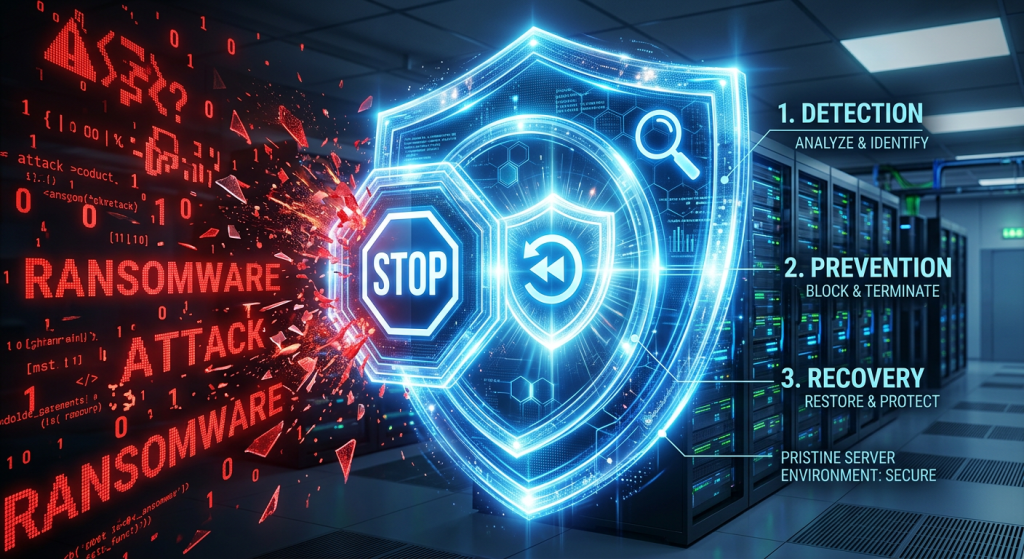
As HYCU rolls out its integration with Halcyon, organizations should expect to gain three core capabilities through a unified solution:
- Detect: Identify ransomware behavior directly on endpoints and production workloads before backup data is impacted.
- Prevent: Stop ransomware activity, including encryption and exfiltration attempts, reducing the number of attacks that can ever reach backups.
- Recover: Enable rapid, application-centric recovery across hybrid and multi-cloud environments.
More importantly, organizations will obtain integrated ransomware protection and recovery capabilities across their entire IT infrastructure. Some other solutions already offer similar capabilities for a specific application, where organizations can detect, prevent, and recover from ransomware.
The integration between HYCU and Halcyon changes that dynamic. Rather than just having this capability for one application, organizations will be able to detect, prevent, and recover from ransomware enterprise-wide. HYCU’s R-Shield already provides protection across cloud, on-premises, SaaS, and hybrid environments. The solution is expected to extend these detect, prevent, and recover capabilities beyond a single application or workload to many more.
Further, organizations will be able to manage this functionality centrally through HYCU’s cloud-based R-Shield console. This will facilitate alerting, awareness, communication, and recovery operations across an organization to coordinate a ransomware response while still respecting internal boundaries.
Ransomware Resilience Becoming a Reality
Organizations do not need every cybersecurity and data protection software available on the market. However, they must deploy the right cybersecurity and data protection software in their environment, and they need it to work together.
HYCU and Halcyon individually offer cybersecurity and data protection software that organizations need to protect their IT environment. By integrating them to detect, protect, and recover, they offer organizations the ransomware resilience that they need. But perhaps most importantly, organizations may now swiftly and efficiently orchestrate their response to a ransomware attack, regardless of the attack’s scope.
KEEP UP TO DATE WITH DCIG
To be notified of new DCIG articles, reports, and webinars, sign up for DCIG’s free weekly Newsletter.
To learn about DCIG’s future research and publications, see the DCIG Editorial Calendar.
Technology providers interested in licensing DCIG TOP 5 reports or having DCIG produce custom reports on their behalf, please contact DCIG for more information.
Editor’s note: HYCU is a client of DCIG.