
The days of building a customized private cloud based upon VMware’s features have ended. Broadcom’s decision to stop licensing vSphere as a standalone solution makes that apparent. This change in software licensing will force organizations to do more than identify viable VMware alternatives.
Instead, they must consider how they will implement a private cloud going forward. This requires that they identify providers that offer the private cloud functionality they seek. To do so, they must first define the features they want a private cloud to possess.
VMware: The De facto Private Cloud
Until now, few organizations had to examine in advance what features they wanted their private cloud to possess. While this statement represents generalization, they could simply select and deploy VMware enterprise wide. They then picked from VMware’s and its partners’ feature menu and implemented the private cloud they wanted.
For instance, they could:
- Purchase VMware software and server hardware from multiple providers separately and assemble a private cloud themselves.
- Introduce an external storage array that VMware could manage.
- Acquire a private cloud that came bundled and pre-configured with VMware software and hardware.
- Extend their VMware private cloud into any number of general-purpose clouds.
In short, VMware made it relatively easy for organizations to build a private cloud using VMware. VMware offered multiple options to build a private cloud. Organizations could then pick the features they wanted to customize the private cloud to their needs.
However, Broadcom has permanently changed how organizations should think about building private clouds using VMware. Broadcom now offers two baseline, private cloud options: VMware Cloud Foundation (VCF) and VMware vSphere Foundation (VVF). If these two options do not suit their taste (or their budget), they must look elsewhere.
Private Cloud Alternatives
DCIG recently completed its research into 19 VMware alternatives, publishing multiple TOP 5 reports on this topic.
In researching these solutions, organizations may recreate many of the private cloud architectures that VMware used to offer. They also cannot recreate some of the configurations previously supported by VMware. Further, these VMware alternatives offered some new private cloud options for organizations to consider.
Deployment
DCIG specifically examined how organizations may deploy these solutions into their IT environments. DCIG uncovered the following:
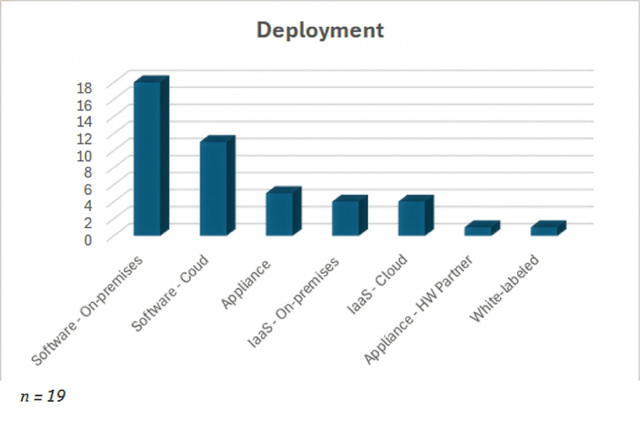
Many VMware alternative providers try to match what VMware used to offer or currently offers. For instance, deploying software on premises represented the most supported deployment option with cloud deployment a close second.
However, organizations may obtain a private cloud offering as an infrastructure-as-a-service (IaaS) from some providers. Four support IaaS either on premises or in the cloud that approximates Broadcom’s VCF and VVF offerings. One VMware alternative even partners with a hardware provider to deliver its private cloud as a pre-integrated appliance.
Some providers have started offering some deployment options that VMware has not traditionally offered. Organizations may obtain a private cloud solution as a preconfigured appliance bundled with server hardware and software directly from five providers. One provider even gives managed service providers (MSPs) the option to white label its private cloud solution.
Software Licensing
Software licensing represents another feature that every organization must consider. In evaluating software licensing on VMware alternatives, DCIG identified at least 12 different ways providers may license their software.
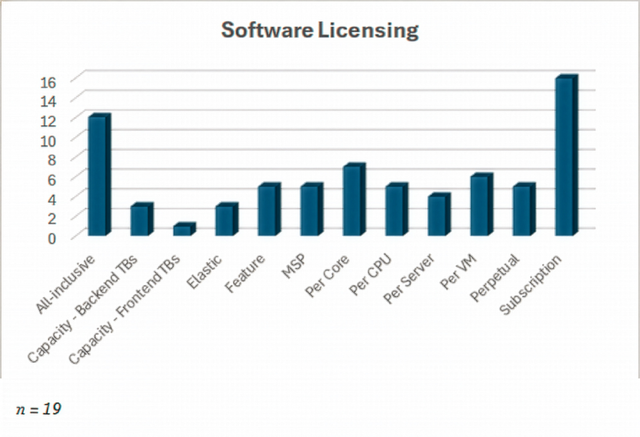
Here again, none of the providers support any single licensing option. Subscription (16 products) and all-inclusive (12 products) software licensing represent the two most supported options. Even then, organizations cannot make any assumptions. For instance, if a provider supports subscription-based licensing, it does not automatically include all-inclusive software licensing.
Further, organizations should assume that they will need to account for three or more software licensing options when calculating costs. For instance, a private cloud solution may offer all-inclusive, subscription-based software licenses that it licenses by per CPU core. This may represent just one of multiple software licensing scenarios available from a provider.
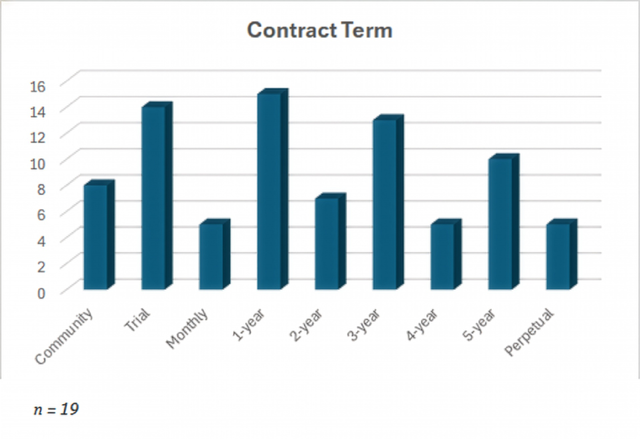
Finally, organizations must consider the software licensing period as they will find at least nine different contract terms available. A 1-year software license available from fifteen providers represents the most common contract term. They will also find community and trial editions along with contract term lengths running from monthly to perpetual.
Only Scratching the Surface
Deployment options, software licensing, and contract terms only scratch the surface of private cloud features that organizations must consider. To make an informed decision about a private cloud solution, they must examine as many of its features as possible.
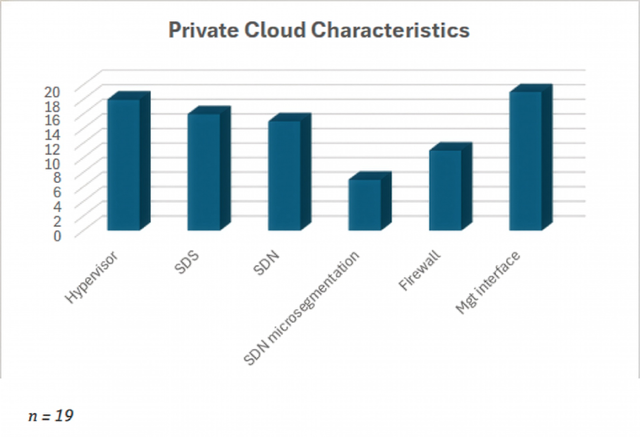 For instance, organizations might assume all private clouds offer a hypervisor as part of their solution. As DCIG’s research uncovered, one cannot even make that assumption. Rather, an interface to manage VMs, storage, and networking represents the only feature common across all private cloud solutions.
That said, organizations will certainly find many private cloud offerings that support the core features they want. Software-defined storage (SDS) and software-defined networking (SDN) represent common components across available offerings, with ~80 percent supporting them. But if they need the private cloud to include a firewall or SDN microsegmentation, they will find those features less supported.
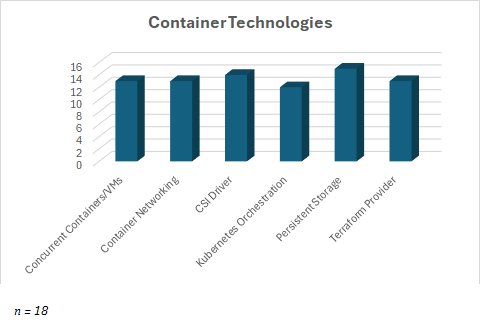
Further, more organizations will consider where they may want to go next. Moving off VMware may represent only a near-term tactical objective. They want flexibility to use the private cloud to use containers and Kubernetes in their environment.
Organizations will find many private clouds from VMware alternatives well-positioned to help them adopt these new technologies. Well over 50 percent of evaluated solutions permit running containers and VMs concurrently. Organizations will also find technologies such as a CSI driver, persistent storage, and a Terraform provider available on many products.
Verge.IO’s Integrated Private Cloud Stack
Documenting and understanding the private cloud functionality that an organization will use immediately and over time increases its probability of success. In making that decision, it should consider solutions that offer:
- Simple-to-understand and implement software licensing.
- Flexibility to re-purpose existing server hardware.
- The core software functionality they need to implement a private cloud.
- Next-gen features ranging from artificial intelligence to containers and Kubernetes.
An organization looking for a solution that matches these and other requirements should consider Verge.io VergeOS. VergeOS integrates compute virtualization, distributed storage, networking, and data protection into a single control plane.
Operationally, VergeOS behaves like a private cloud that possesses an infrastructure operating system. It includes storage policies, snapshots, replication, and recovery that take the entire private cloud stack into account.
However, VergeOS treats and manages this stack as one entity. This permits VergeOS to non-disruptively roll upgrades through the system and support mixed hardware generations. Further, IT teams may manage the VergeOS private cloud as a single system rather than coordinating the management of multiple products within the cloud.
The Private Cloud Reset
Any organization moving away from VMware – which probably means nearly everyone at some level – must reset their private cloud expectations. They no longer should expect to select a single provider today that supports multiple ways to implement a private cloud. Rather, they should figure out which options they want before they select a private cloud.
Everyone must first reset their expectations about the few VMware private cloud options that remain available to them. Many will find these options either insufficient, too costly, or both. The rest will find themselves compelled to explore options available from other private cloud providers.
The better that they do at documenting their requirements, the better their new private cloud experience will be. VergeIO and its VergeOS private cloud platform open the door for organizations to get the private cloud they need now while positioning them to meet their future requirements.
KEEP UP TO DATE WITH DCIG
To be notified of new DCIG articles, reports, and webinars, sign up for DCIG’s free weekly Newsletter.
To learn about DCIG’s future research and publications, see the DCIG Editorial Calendar.
Technology providers interested in licensing DCIG TOP 5 reports or having DCIG produce custom reports on their behalf, please contact DCIG for more information.
Note: VergeIO is a client of DCIG.