
 Every “best” product for enterprise IT environments tends to share the same challenge. All the features that make them well-suited for these IT environments often make them complicated to use. Commvault arguably fell into this category until today. Its announcement of Commvault Cloud Unity has removed the requirement for enterprises to be smarter than Commvault to use Commvault.
Commvault Cloud: Great Enterprise Solution But …
Commvault represents a data protection provider that DCIG has covered for over 20 years. From the days when Commvault focused on midmarket enterprises to serving large enterprises, DCIG has followed its evolution. However, as often occurs, tackling the complexities of enterprise data protection results in the product itself becoming complicated to manage.
Having worked in enterprises, I appreciate the challenges that enterprise data protection solution providers such as Commvault face. Just some of the tasks their solution “must do” include:
- They must protect modern and legacy operating systems.
- They must account for cloud, hybrid, physical, and virtual environments.
- They must protect all the applications running in those environments.
- They must scale and manage their own solution on the backend.
- They must work with and integrate with multiple different backup targets.
- They must work with snapshot and replication features on storage systems.
- They must now protect SaaS applications and the vast amount of data generated by AI.
Then, while delivering on all these must-dos, the solution must also remain cost-effective and simple to manage. Otherwise, the cure becomes worse than the solution. Users of Commvault had to be smarter than Commvault to effectively manage Commvault.
Adding insult to injury, enterprises will adopt other products that solve specific data protection pain points for one simple reason. They were easier to manage because they did one task well and more economically.
Based on Commvault CEO Sanjay Mirchandani’s comments during his keynote speech, Commvault had succumbed to this dilemma. It could theoretically protect many, if not all, applications and data in enterprise environments. However, enterprise environments were so complex, that Commvault had, by default and out of necessity, become too complex to manage.
Mirchandani explicitly mentioned that Commvault had invested millions of dollars to make its product easier to manage. It made multiple enhancements to its user interface. However, as soon as it did so, new user requirements would emerge, negating some of its efforts. So, despite investing millions and spending years on this initiative, Commvault still found itself in this conundrum.
Commvault Turns to AI to Make Commvault Simpler to Manage
Commvault then did what more enterprises now do: it turned to AI to make Commvault simpler to manage. Commvault introduced this functionality as part of its Commvault Cloud Unity release in at least the following three ways:
First, Commvault Cloud Unity leverages AI to let users create the user experience they want.
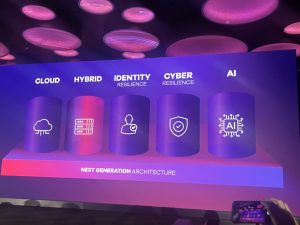 Commvault had spent many years and millions of dollars seeking out the “best” or “most universal” user interface. Turns out, it did not exist. Different users in different enterprises have different requirements. They always have and they always will.
However, by introducing an AI interface into Commvault Cloud Unity that resembles a Google or ChatGPT interface, Commvault effectively solved this challenge. Now users can simply ask Commvault a question or instruct it to generate the interface or information they want. Presto, Commvault Cloud Unity now produces it.
Second, Commvault Cloud Unity transforms backup from an insurance policy into a mission-critical operational solution.
Backup has operated for decades in the background within enterprises as essentially an insurance policy. You must create backups but pray you never have to use them because no one ever fully tests them.
Commvault Cloud Unity turns that model on its head. It could already perform backups anywhere in the enterprise – cloud, on-premises, physical, or virtual. However, its deep integrations with so many technologies allowed Commvault to take the next logical step. It can now use AI to perform backup and recovery tasks that users typically must perform.
Rather than users having to identify which backup to use, or which data in multiple backups to use, Commvault handles this task. Referred to as ResOps, or Resilience Operations, Commvault can identify the data for recovery, scan it for malware, and even initiate the recovery.
Now, how broadly Commvault does this or will it work in every situation, is unclear. That said, based on how fast AI can evolve and mature, I anticipate that Commvault Cloud Unity will rapidly improve its capabilities in this area.
Further, DCIG has separately spoken to HPE and Hitachi. They both utilize and manage Commvault in customer environments and have spoken highly of their success with it. So Commvault Cloud Unity may be more mature than even Commvault currently lets on.
Third, Commvault Cloud Unity has transitioned from backup and recovery to production.
A reliable backup and recovery solution is great. But what is even better? Identifying an issue before data loss or an outage occurs, so one never has to recover in the first place.
To meet that objective, Commvault has leveraged its Satori acquisition to introduce identity management into Commvault Cloud Unity. By monitoring and tracking access to production data in real-time, it can better identify threats as they occur in real-time. In this way, Commvault can act whether a user makes a mistake or an external bad actor initiates an attack.
You No Longer Have to be Smarter than Commvault to Use Commvault
No one likes to admit they are either ignorant or incompetent. However in today’s complex enterprise IT environments, there is no one smart or competent enough to fully understand them. However, someone or something must understand these complex enterprise IT environments to create a resilient IT environment.
Commvault smartly recognized that to create this resilient or ResOps environment, it needed to introduce AI into its solution. In so doing, Commvault did more than make Cloud Unity a powerful solution. It made it so the individuals who manage Commvault no longer have to be smarter than Commvault to use it.
KEEP UP-TO-DATE WITH DCIG
To be notified of new DCIG articles, reports, and webinars, sign up for DCIG’s free weekly Newsletter.
To learn about DCIG’s future research and publications, see the DCIG Editorial Calendar.
Technology providers interested in licensing DCIG TOP 5 reports or having DCIG produce custom reports on their behalf, please contact DCIG for more information.