
Organizations may not yet fully grasp how much their daily operations depend upon software-as-a-service (SaaS) and hybrid clouds. Already about 80 percent of organizations use third-party SaaS applications with 80 percent also utilizing hybrid clouds.
Yet as SaaS applications and hybrid cloud environments have become commonplace, providing holistic, resilient data protection for them remains elusive. Organizations must be far more purposeful, and thoughtful, in selecting a solution that protects data stored across these environments. HYCU’s introduction of Resiliency Shield (R-Shield™) gives organizations new flexibility to deliver data resilience across this mixed IT environment.
Challenges of Holistic, Cyber Resilient Data Protection
Holistically and resiliently protecting data stored across multiple clouds, on-premises, and SaaS applications presents significant challenges. Chief among them includes simply identifying a solution that can protect this complex environment. A solution that holistically protects data across these environments must offer features such as:
- Offering protection across these disparate environments.
- Protecting the diverse set of applications and data typically hosted in them.
- Providing a roadmap for protecting new and emerging applications.
- Centrally managing the data protection solution.
- Protecting itself and its backup data from attacks.
- Providing the necessary options to recover the data.
To deliver on all these features, the solution must also address the specific challenges associated with each feature.
For example, organizations themselves may not have a single individual or group that manages data protection across all this environment. One group may manage protection for on-premises applications, another may manage cloud protection, and still another manages SaaS application protection. In some cases, individuals may manage data protection for a specific cloud, on-premises, or SaaS application. The solution must accommodate for these different ways that organizations often manage data protection.
Data protection solutions must also protect – or provide a roadmap for protecting – all the SaaS applications that organizations use. Many data protection solutions protect data hosted in broadly adopted SaaS applications, such as Microsoft 365, Google Workspace, or Salesforce. However, these represent just a fraction of the SaaS applications in the market.
Even assuming a data protection solution delivers on these requirements, organizations must still evaluate how the solution:
- Secures backup data
- Stores backup data
- The options it provides for performing recoveries.
HYCU R-Shield™ Builds Heightened Cyber Resilience into R-Cloud™
HYCU has already established itself as a leader in hybrid cloud data protection with HYCU R-Cloud™. Offering data protection for multiple clouds, hypervisors, and on-premises environments, organizations can use HYCU R-Cloud to centrally protect them all.
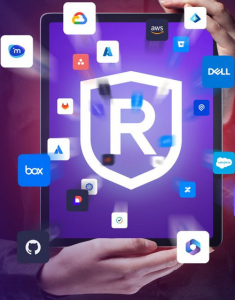 HYCU R-Cloud has also uniquely established itself as a leading SaaS data protection solution. Already supporting more than 50 SaaS applications, HYCU R-Cloud has taken an early and commanding lead in SaaS data protection. HYCU makes its APIs available to SaaS providers to embed them in their application. In this way, HYCU R-Cloud can then back the data in them up and restore the data as required.
To these capabilities HYCU now introduces R-Shield™ to build heightened cyber resilience into R-Cloud’s existing data protection platform. R-Shield specifically addresses cyber resilience concerns that exist across all clouds, on-premises, and SaaS environments.
Secures R-Cloud Backup Infrastructure
Bad actors – be they hackers or insider threats – often first seek to compromise backups or the backup software. They may attempt to gain administrative access to the backup solution itself or changing, deleting, or encrypting backups.
To prevent unauthorized access, HYCU makes R-Cloud available as a subscription cloud service that recently achieved a Common Criteria security certification. Organizations can also opt to deploy and run HYCU R-Cloud on a hardened Linux operating system that has a DISA-STIG certification.
R-Shield brings to R-Cloud’s existing security capabilities the following additional cyber resilience capabilities:
“Cloaks” or hides backups from bad actors.
Organizations often store their backups on shared external storage – be it network attached or object storage. Storing backups on shared storage can, however, make them susceptible to discovery and compromise by hackers and ransomware.
To prevent these malicious activities, R-Shield continuously scans all external storage where R-Cloud stores backups. During these scans, R-Shield checks the file and object storage permissions on each storage device. It verifies that only R-Cloud can access these storage devices and generates alerts if other applications or users can access them.
Introduces R-Lock™ to provide immutable storage owned and controlled by the organization.
As more organizations use cloud storage for backup, many fail to ask, “What happens if they switch cloud providers?” Backups stored in an immutable format in the cloud means they potentially cannot change or delete backups for years. This scenario may lock organizations in with a cloud provider until their backups expire and they can delete them.
R-Shield’s R-Lock feature prevents this situation with organizations retaining control and ownership of their backups. Using R-Lock, organizations can choose to store data in a location that they control or own. This location may be either on premises or with another cloud provider.
R-Cloud then relies upon R-Lock to store backups in complete isolated tenancy outside of the production infrastructure. Organizations may also choose to store backups in locations to meet their data sovereignty concerns and then set retention policies accordingly.
Offers both built-in anomaly and ransomware detection.
Many enterprise backup software solutions offer either anomaly or ransomware detection. In this respect, R-Shield delivering this functionality keeps it on par with its competitors. However, HYCU R-Shield does what many of its competitors do not do in their implementation of anomaly and ransomware detection.
Many competitive backup solutions take an either/or approach: they offer anomaly detection or ransomware detection. However, most do not offer both. HYCU R-Shield offers both techniques to detect ransomware.
Anomaly detection helps organizations detect strains of ransomware that specifically target their organization. HYCU’s anomaly detection feature monitors variations in data change rate analyzing the data after backups are complete.
Its ransomware detection follows the same post backup process when analyzing data for ransomware. However, when scanning for known ransomware strains, R-Shield does signature scanning based upon publicly available sources. Further, organizations may add their own sources to which they may subscribe to R-Shield. HYCU will then also use those sources provided by the organizations when scanning backups for ransomware.
Recovery validation.
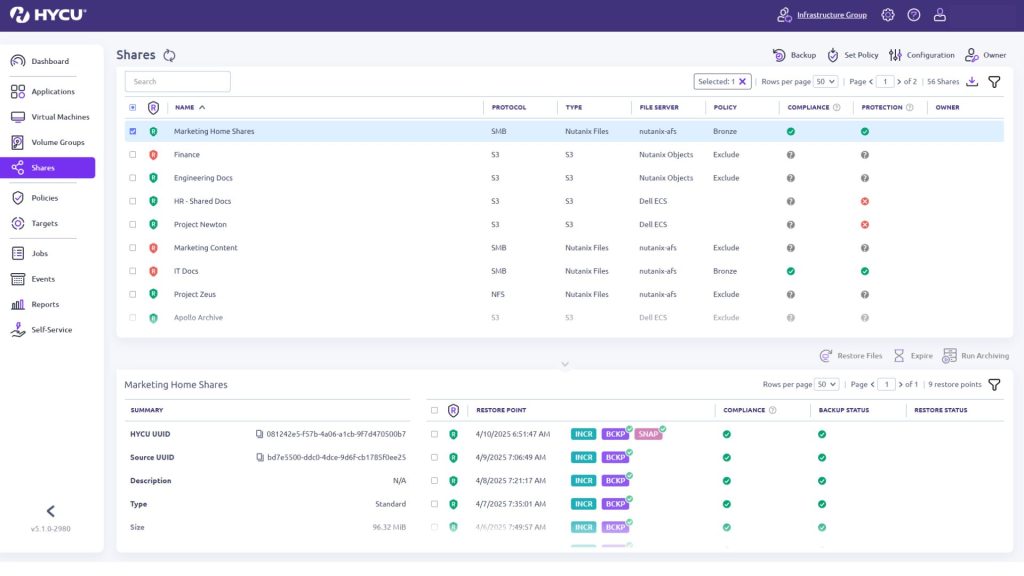
Having secure backups only helps if organizations can recover them when they need them as quickly as they need them. R-Shield helps on this front as well. As part of its continuous scanning process, R-Shield monitors backup target and network performance response times. Based upon this data, it calculates how long it will take an organization to recover their data. It constantly updates this estimate, so organizations always know their recovery time.
HYCU R-Shield Makes Cyber Resilience Available to an Organization’s Entire Data Estate
Organizations cannot pretend that any of their IT environments operate on an island. The threats in today’s world dictate they must protect their entire data estate – be it cloud, on-premises, and SaaS. To effectively deliver on this objective, a data protection solution must monitor it, protect it, and have backups always ready for recover.
While HYCU R-Cloud already delivered on these requirements, HYCU’s introduction of R-Shield served to bolster its cyber resilience capabilities. By cloaking backups from bad actors, keeping backups in an immutable state, scanning ransomware in backups, or verifying an organization’s recovery readiness, HYCU delivers functionality few other competitors can offer. HYCU R-Shield provides organizations with protection across their entire data estate – clouds, on-premises, and SaaS – while giving them new confidence that they can secure and recover their backups.
KEEP UP-TO-DATE WITH DCIG
To be notified of new DCIG articles, reports, and webinars, sign up for DCIG’s free weekly Newsletter.
To learn about DCIG’s future research and publications, see the DCIG Editorial Calendar.
Technology providers interested in licensing DCIG TOP 5 reports or having DCIG produce custom reports on their behalf, please contact DCIG for more information.