
DCIG is pleased to announce the immediate availability of the 2025-26 DCIG TOP 5 Enterprise SDS Object Backup Target Report. This DCIG TOP 5 report provides enterprises with guidance on the best SDS object backup targets for deployment in today’s enterprise backup environments.
Two Corporate Priorities Driving SDS Object Backup Target Adoption
Twenty years ago, enterprises started adopting disk in lieu of tape as their primary backup target. Now enterprises have started to make another change in their choice of backup targets. These new backup targets still use disk as their underlying storage media. However, more providers deliver backup targets as software-defined storage (SDS) with a simple storage service (S3) object interface.
Two corporate operational priorities currently drive this trend of enterprises seeking out SDS object backup targets.
First, enterprises now embrace a hybrid cloud strategy. While hybrid cloud usage among enterprises varies, adoption rate estimates generally range from 80 to over 90 percent. When pursuing this strategy, enterprises often continue to perform backups and recovery. Indeed, backup and recovery may represent the primary way that enterprises implement their hybrid cloud strategy.
However, few if any cloud providers make provisions for enterprises to host physical backup targets in their cloud environments. Instead, to obtain backup functionality like they have on-premises, enterprises must deploy a backup target in the cloud. This requirement has prompted enterprises to seek out SDS backup targets in general, and SDS object backup targets specifically.
Second, every enterprise must deal with the threat of ransomware. Object backup targets better position enterprises to deal with ransomware’s threat as they can withstand a common ransomware attack method.
Most ransomware begins its attack by seeking out backup targets and attempting to delete or encrypt backups on them. SDS object backup targets guard against these attacks by storing backups in an immutable format. Further, they help enterprises restore and recover their data more quickly and economically.
SDS object backup targets also put enterprises in control of how much they spend on achieving these two corporate priorities.
Using SDS object backup targets, they can potentially re-use storage hardware they already own. SDS object backup targets can virtualize and then manage multiple storage types. These types range from high-performance solid-state drives (SSDs) to cost-effective, high-capacity hard disk drives (HDDs) or even cloud object storage.
In so doing, enterprises may implement SDS object backup targets to achieve these competing corporate priorities without breaking their budget.
The State of Enterprise SDS Object Backup Targets
Providers recognize that enterprises evaluate how well current SDS object backup targets align with today’s two top corporate operational priorities. Therefore, it should not be surprising that all SDS object backup targets offer both hybrid cloud and data immutability capabilities.
However, enterprises must look below the covers to quantify how each SDS backup target delivers on these operational priorities. Providers employ different methods to deliver on these requirements that may or may not meet a specific enterprise’s requirements.
Level 1 and Level 2 Hybrid Cloud Implementations
All evaluated SDS object backup targets support hybrid cloud implementations at two levels.
- Level 1: Tier data to a general-purpose cloud, purpose-built storage cloud, or private storage cloud.
- Level 2: Deployment options that include the SDS object-based backup target operating both on-premises and in the cloud. While they support both these levels, differences exist between how they support each hybrid cloud level.
Level 1
For Level 1 hybrid cloud support, each SDS object backup target can tier data to other clouds. They offer this cloud tiering for disaster recovery purposes and to create air-gapped copies of backups. The differences between the SDS object backup targets emerge in the clouds they support and how they implement cloud tiering.
While each SDS object backup target supports tiering to other cloud storage, no one product supports tiering to all available cloud storage options. Further, they may differ in the options they offer enterprises to tier backups to other cloud storage.
For example, some may only offer options to tier data that satisfies certain policies or reach a certain age. Others may offer sophisticated algorithms or use artificial intelligence that tracks all data access and usage. It then only moves data that meets specific criteria or, when moving data, places it more intelligently in the cloud.
Level 2
To deliver Level 2 hybrid cloud functionality, providers make their solution available in the three configurations that enterprises most often need. They may minimally obtain them as:
- Pre-integrated physical appliances.
- Virtual appliances are supported by major cloud and hypervisor providers.
- Software installable on bare metal servers.
Few SDS object backup targets support all three of these deployment options. However, enterprises will find each product supports at least two of them. Providers usually make one deployment option optimized for on-premises and the other optimized for the cloud.
Enterprise Backup Software Support
Enterprises will also find that most enterprise backup software natively supports these SDS object backup targets. Minimally, enterprise backup software recognizes the S3 API interface that each SDS object backup target presents. This recognition permits backup software to store and retrieve backups from any enterprise SDS object backup target.
However, the specific S3 API operations that each backup software and SDS object backup target support will vary. These may support multipart upload, object lock with different data immutability options, replication, and server-side and storage-side encryption, among others.
These differing levels of support for S3 API operations introduce at least two levels of complexity into the decision-making process. First, no SDS object backup target supports every S3 operation. If an enterprise needs to perform a specific operation, such as object lock, it should verify the backup target supports it. Further, an enterprise must also verify the backup target implements the operation in the way they intend to use them.
Second, an SDS object backup target supporting an S3 API operation does not equate to backup software supporting it. Each enterprise backup software supports different S3 API operations. Further, it may not support the nuances of every S3 API operation. For instance, backup software supporting S3 object lock does not automatically mean it supports how a backup target implements it.
Enterprises can take steps to minimize some of these issues. For instance, they can prioritize choosing backup targets that offer certified solutions or reference architectures with their preferred backup software.
2025-26 DCIG TOP 5 ENTERPRISE SDS OBJECT BACKUP TARGETS
In preparing this report, DCIG formally evaluated over 20 different SDS object-based backup targets of which 17 met DCIG’s criteria for an enterprise SDS object backup target. The general categories under which the features of these SDS object backup targets fell included:
 API/Network Protocol Support
- Cyber Security and Data Protection
- Management
- Software Architecture
- Technical Support
 API/Network Protocol Support
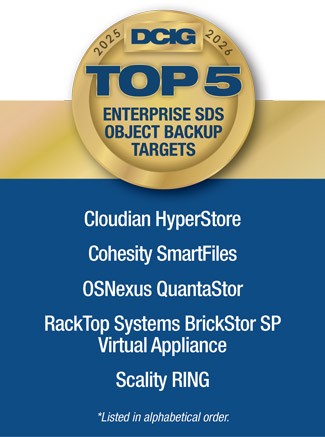
Based on these criteria, DCIG awarded the following enterprise SDS object backup targets a DCIG TOP 5 ranking:
- Cloudian HyperStore
- Cohesity SmartFiles
- OSNexus QuantaStor
- RackTop Systems BrickStor SP Virtual Appliance
- Scality RING
REPORT AVAILABILITY
The full 2025-26 DCIG TOP 5 Enterprise SDS Object Backup Target Report is available for download immediately on DCIG’s site with registration by following this link. The full report contains additional details such as:
- A list of the 17 SDS object-based backup targets evaluated.
- Available cyber security features on SDS object backup targets.
- Common features across all enterprise SDS object backup targets.
- Nine distinguishing features of the DCIG TOP 5 Enterprise SDS Object Backup Targets.
- Differences between the DCIG TOP 5 Enterprise SDS Object Backup Targets.
- A profile of each DCIG TOP 5 Enterprise SDS Object Backup Targets that lists at least three (3) ways each one distinguishes itself from the other solutions.
CONFIDENTIALITY AND COPYRIGHT
Other than excerpts from this report published in this announcement, the content of the 2025-26 DCIG TOP 5 Enterprise SDS Object Backup Target Report is copyrighted and may not be republished without the express written permission of DCIG.
KEEP UP TO DATE WITH DCIG
DCIG will release more DCIG TOP 5 reports in the weeks and months to come. Please sign up for the weekly DCIG Newsletter to receive notice of their availability.
To learn about DCIG’s forthcoming research and publications, see the DCIG Publication Calendar.
Technology providers interested in licensing DCIG TOP 5 reports or having DCIG produce custom reports, please contact DCIG for more information.